Customer Login
Article by JBH. July 17th, 2026.
A new pair of executive orders signals that quantum technologies are no longer a future problem. They’re a present one.

On June 22, 2026, the White House signed two executive orders that will reshape how organizations think about data security and quantum deployment over the next five years. Together, they mark the federal government’s most concrete step yet toward preparing the country for an era when quantum computers can break the encryption that underpins financial institutions worldwide.
If you don’t sell to the federal government, it’s tempting to file this under “not my problem.” That would be a mistake. The orders set a national timeline for a security transition that every organization handling sensitive data will eventually need to make, and the risks they’re responding to are already active. Taken together, they represent the clearest signal yet from the federal government that the quantum era is not approaching, but instead already underway.
What the Orders Actually Say
The first order, EO 14412 – Securing the Nation Against Advanced Cryptographic Attacks, addresses the urgent and underappreciated risk posed by encryption. The advent of large-scale quantum computers, particularly in the hands of adversaries, poses a significant threat to contemporary cryptographic security systems. Adversaries are collecting sensitive information from the U.S. today with the plan to decrypt it later, once large-scale quantum computers become operational (HNDL, or “harvest now, decrypt later,” schemes). In response, the directive requires federal agencies to transition their high-value assets to quantum-resistant encryption (also known as post-quantum cryptography (PQC), with a deadline of December 31, 2030, for primary establishment.
The second order, EO 14413 – Ushering in the Next Frontier of Quantum Innovation, looks forward, focusing on the buildout of quantum infrastructure. It establishes a national effort to build the first quantum computer capable of driving a new era of scientific discovery, and it directs a whole-of-government approach to speed up the deployment of quantum computing, sensing, and networking.
EO 14413 launches the Quantum Computer for Application Development and Discovery Science (QC-ADDS) effort, a national push to deliver a large-scale quantum computer to a Department of Energy facility and expand the broader U.S. quantum ecosystem. This large-scale quantum computer is likely to be at one of the 17 National Laboratories overseen by the D.O.E.
Read together, the orders reflect a dual strategy: race to build powerful quantum computers while simultaneously racing to protect data from what powerful quantum computers can do to today’s encryption.
Trump signed the orders alongside tech leaders, including Google’s president and IBM’s CEO, calling them a “big step forward” for the U.S. in the sector.

Why This Matters for Infrastructure
Federal policy rarely moves fast. When it does, it tends to pull the private sector along for the ride. After the events of September 11th, 2001, the creation of the TSA didn’t just change how airports operated; it rewired the economics of an entire industry within months. The 2030 deadline for the post-quantum cryptography migration isn’t just a government IT problem; it applies to contractors, critical infrastructure operators, financial institutions, and their existing networks.
Cybersecurity experts are particularly concerned that U.S. adversaries could steal data today and decrypt it using a quantum computer in the future, known as “harvest now, decrypt later” strategies. Encryption standards like RSA and elliptic-curve cryptography, which secure everything from banking transactions to internal emails, rely on math problems that are effectively impossible for classical computers to solve. A sufficiently advanced quantum computer could solve them in minutes.
The timeline for Q-Day, the moment when quantum computers become capable of breaking current public-key cryptography, has accelerated following research breakthroughs by Google and others earlier this year, with some estimates now placing it as soon as 2029.”
What This Means if You’re Not a Federal Contractor
Even organizations with no government contracts have reasons to pay attention now rather than in 2029.
As cloud providers, software vendors, and infrastructure partners update their products to meet federal PQC requirements, those changes will appear in the tools businesses use worldwide. And history suggests that transitions like this always take longer than anyone plans for. Replacing cryptographic algorithms embedded across systems, applications, and hardware is a multi-year undertaking that involves inventorying, testing, and a phased rollout. Look no further than the Y2K remediation effort, except this time the threat isn’t hypothetical or bound by a fixed deadline. Wait too long, and migration stops being a choice. It becomes a scramble.

60 Hudson: The Building That Has Always Adapted
60 Hudson has been here before. Not specifically with quantum, but with the same underlying dynamic: a technology shift that seemed distant suddenly becomes immediate, and the places best positioned to handle it are those that never stopped investing in their physical and network foundations.
When fiberoptic cables arrived, 60 Hudson was ready because its floors, power capacity, and downtown Manhattan location made it a natural meeting point for carriers racing to interconnect. Today, millions of miles of fiber optic cables connect Europe to the heart of Tribeca, with over 70% of New York’s internet traffic passing through our walls.
With today’s infrastructure development, quantum networking will follow a similar logic. The question won’t just be who builds the quantum hardware; it will be where that hardware connects to everything else.
QTD Systems operates at that intersection. Inside 60 Hudson, we have one of the densest carrier ecosystems in the country. We’re watching these executive orders not as a distant policy development but as a signal of where the next wave of infrastructure investment is headed.
Organizations that start their quantum readiness planning now will have a monumental advantage over those that wait. If you want to understand what that means for your infrastructure, start by looking at where your data moves. For many of the world’s most connected companies, that conversation starts at 60 Hudson Street.

Industry Insights: IBM’s Starling Roadmap and the Need for Quantum Infrastructure
Industry Insights: What July Taught Us About Quantum Computing
Industry Insights: The Nation’s Quantum Moment and What It Means for 60 Hudson Street

Live ‘Quantum Network’ Being Tested in New York — Overcoming Key Hurdles Could Bring Us Closer to an ‘Unhackable’ Internet

DE-CIX expands its Big Apple footprint with ‘quantum-enabled’ interconnect

Scientists Take a Step Toward a Quantum Internet Using New York City’s Fiber
Inside the Company Selling Quantum Entanglement
Qunnect and Cisco Demonstrate Quantum Entanglement over a Quantum Network in New York City
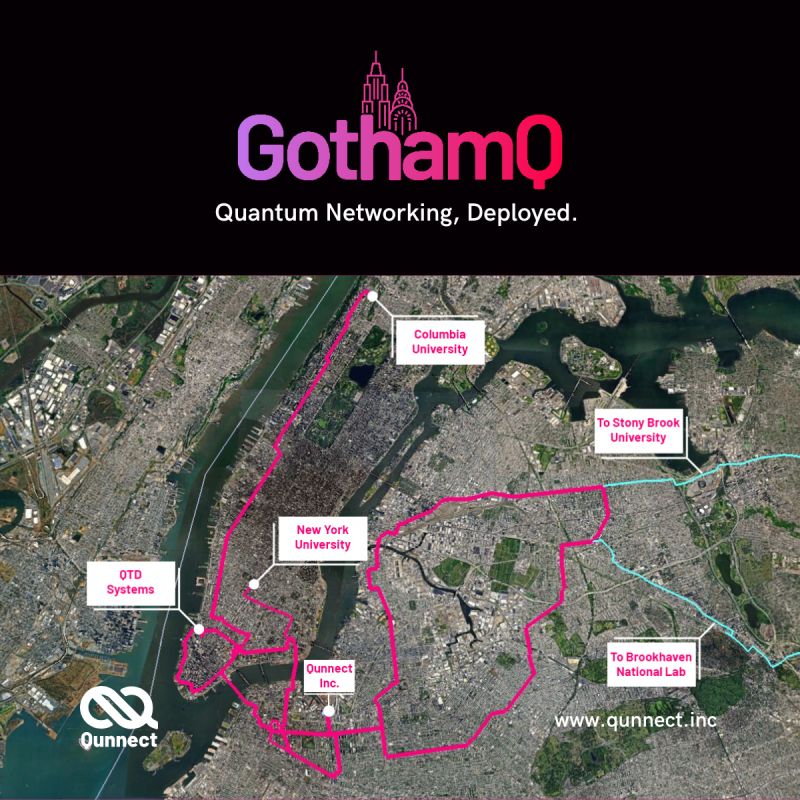
Qunnect and Cisco Demonstrate Quantum Entanglement in NYC